
Organic dental leads convert at 14.6%. Paid outbound leads convert at 1.7%. That is not a small difference – that is a near-9x gap in conversion quality, and it is why the practices I see growing most consistently in 2026 are not the ones with the biggest ad budgets. They are the ones who figured out how to get more dental patients without buying expensive leads by building systems that compound over time instead of evaporating the moment a campaign pauses. Here is exactly how they do it.
Why Buying Leads Is the Most Expensive Way to Grow
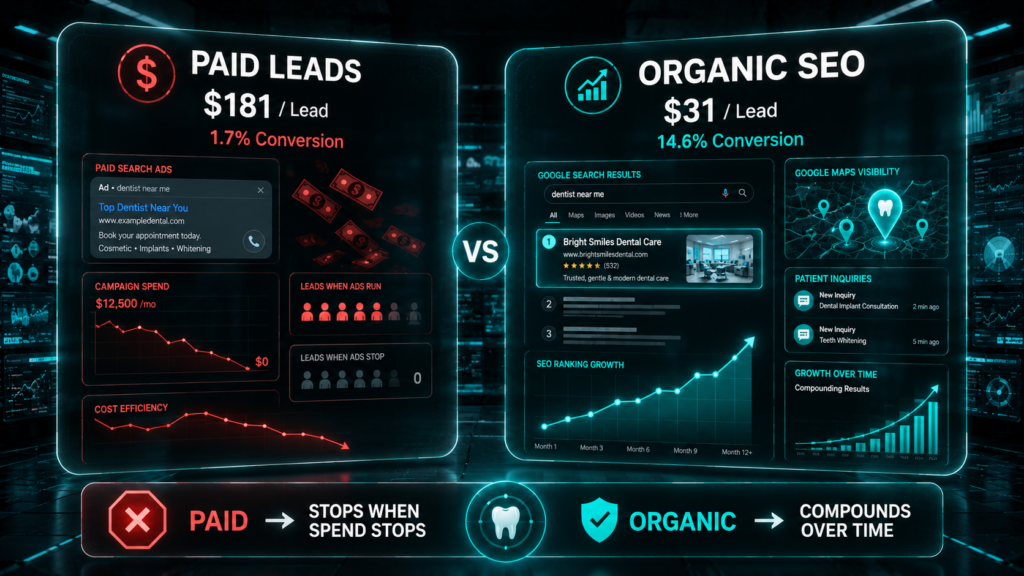
The average cost per lead from paid dental search is $181. Organic SEO brings that number down to approximately $31 – nearly 6 times more efficient. After 12 consistent months of organic SEO, most dental practices see patient acquisition costs drop 60-75% below what they paid for PPC during the same period.
The other problem with purchased leads: they stop the moment the spend stops. An organic search ranking, a fully optimized Google Business Profile, or a high-performing service page continues generating patient inquiries for months or years without ongoing cost. That is compounding ROI. Paid leads have no compound value at all.
The paid vs. organic gap in numbers:
- $181 average cost per lead via paid search vs. $31 via organic SEO
- 14.6% conversion rate for organic leads vs. 1.7% for outbound/paid
- 70-80% of dental searchers skip paid ads entirely and go straight to organic results
- 94% of all Google clicks go to organic results – only 6% to ads. That said, paid social plays a specific role in elective and high-value case generation that organic cannot replicate at the same speed, for practices running both channels, the Facebook and Instagram ad benchmarks for dental practices in 2026 shows what efficient campaign structure actually looks like versus the $77 industry average.
- By month 12 of consistent SEO: 60-75% lower cost per acquisition than PPC
Strategy 1: Dominate Local Search – Know What Your Competitors Rank For
The single most efficient place to acquire dental patients organically in 2026 is the Google Maps Local Pack – the three map-pinned listings that appear above organic results on every local dental search. Practices in those top three positions capture 60-70% of all new patient clicks on mobile.
Getting there requires knowing which keywords are actually driving patients to your competitors – and then building a visibility strategy around them. Understanding your competitive keyword landscape before you create a single page of content is what separates practices that rank in months from those that spend years creating content nobody searches for.
Our guide on what SEO platform works best for tracking competitor keywords covers exactly how to do this before you spend a dollar on content or optimization.
What moves the Local Pack needle:
- Primary GBP category set to “Dentist” – not “Dental Clinic” or “Dental Office”
- Secondary categories added for every high-value service: Cosmetic Dentist, Dental Implants Periodontist, Emergency Dental Service, Orthodontist
- 25+ photos in your profile: exterior, interior, team, clinical environment
- Weekly GBP posts and Q&A updates
Strategy 2: Build Service Pages That Pull High-Value Patients
The single biggest SEO mistake dental practices make is listing every service on one page. That page ranks for nothing because it targets everything. Google needs specificity – one dedicated page per service, per location.
Practices that build this way generate 3x more organic leads than those relying on a single services page, and each well-optimized page can generate 20-50 new patient inquiries per month for 3-5 years without additional spend.
But the content only works if it targets the right keywords – the specific phrases patients are actually typing, not the ones that feel logical to write about. This is where the right SEO tools make the difference between a page that ranks on page one and one that sits invisible on page five.
Our breakdown of which SEO platform offers the strongest keyword research and site audits walks through which tools actually deliver for dental practice keyword targeting.
What each service page needs to rank and convert:
- Target keyword in H1, first paragraph, one H2, and URL slug
- Clinical specifics: cost range, timeline, candidacy, procedure steps
- Named dentist author with credentials – Google requires E-E-A-T signals for health content
- FAQ section with schema markup – captures People Also Ask placements
- One clear CTA above the fold – “Book a Free Consultation” not just “Contact Us”
Strategy 3: Turn Your Google Business Profile Into a Lead Engine
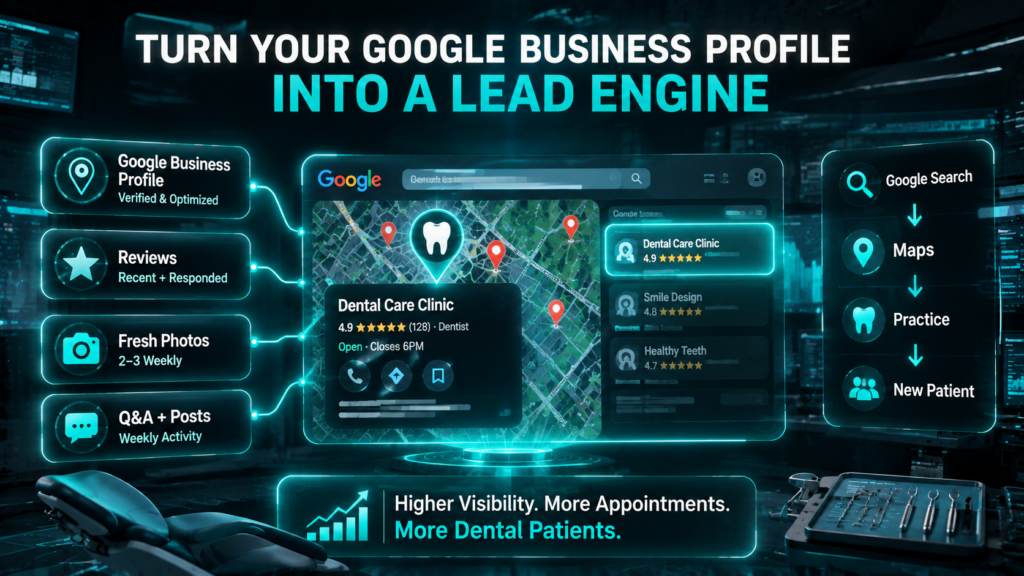
Most practices set up their GBP once and never touch it again. The ones gaining ground treat it as a weekly-managed channel.
96% of prospective patients check reviews before booking. Only 35% of dentists respond to negative reviews – yet 80% of patients expect a response. That gap is a trust opportunity most practices are leaving on the table entirely.
The weekly GBP system that works:
- Add 2-3 new photos every week (exterior, team, clinical)
- Post one update per week – a service highlight, a FAQ answer, a seasonal reminder. A structured dental social media content calendar removes the guesswork from weekly GBP posts and organic social, with ready-made topic hooks, awareness dates, and 30 post ideas built around the same audience you are already trying to reach locally.
- Respond to every review within 48 hours – positive and negative
- Seed the Q&A section with real patient questions and answer them yourself before competitors or confused patients do
A well-run GBP in a mid-sized U.S. market should generate 8-15 new patients per month from organic local search alone – with zero ad spend.
Strategy 4: Make Reviews Generate Patients Automatically
Reviews are not just reputation management in 2026 – they are a direct patient acquisition channel. Practices with 100-200+ Google reviews and consistent recent activity consistently outrank those with stale profiles, regardless of website quality.
What the review data shows:
- 77% of patients check online reviews before choosing a dentist (BrightLocal 2025)
- 96% of prospective patients read reviews before booking
- 74% use two or more review platforms – not just Google
- Stale review profiles (no new reviews in 30+ days) see measurable ranking decline
The review system that runs on autopilot:
- Same-day SMS request after every appointment – timing matters more than platform
- Direct link to Google review page in the message – remove every extra step
- 48-hour response to every review posted – this is also an E-E-A-T signal Google reads
- Consistent presence on Healthgrades, Yelp, and Zocdoc – not just Google
Strategy 5: Keep the Patients You Already Have
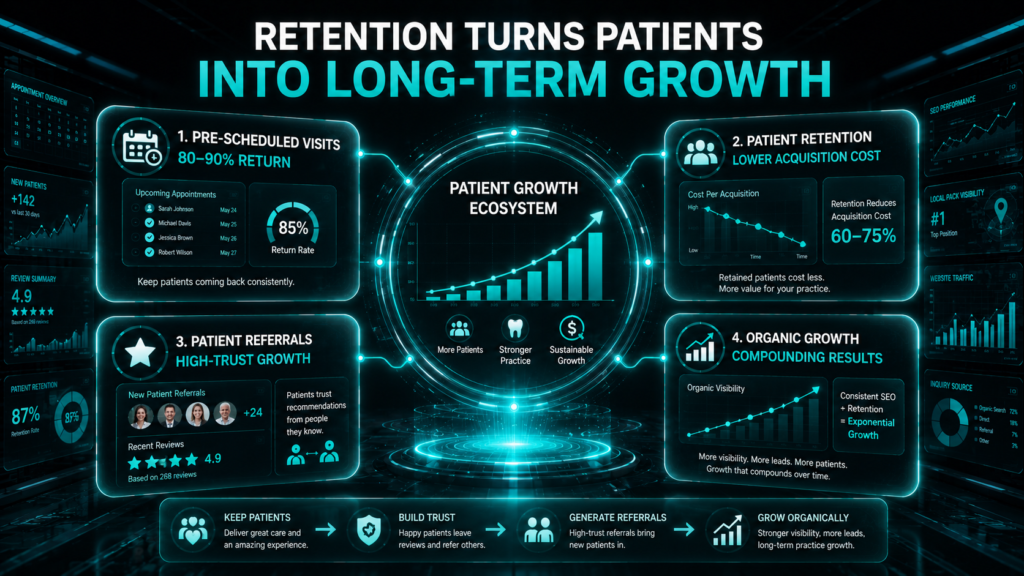
Here is the strategy most practices overlook entirely when thinking about patient acquisition: retention. Pre-scheduled patients return at 80-90% rates. Patients who leave without a next appointment return at only 35-45%. That gap is not a patient loyalty problem – it is a systems problem.
Every patient you keep is one you do not have to pay to acquire again. And patients who stay become your highest-converting referral source – generating word-of-mouth patients who cost nothing and convert at rates no paid campaign can match.
The framework for keeping patients coming back consistently is covered in detail in our guide on dental patient retention strategies that actually work – including the specific systems top practices use to close the 45% gap.
When Does Organic Patient Growth Start Working?
This is the honest timeline from real practice data:
| Timeline | What Happens |
|---|---|
| Months 1-2 | Technical fixes, GBP optimization, baseline keyword research |
| Months 3-4 | Early local ranking improvements, 40-130% organic traffic increase |
| Months 5-8 | First-page rankings for high-value keywords (implants, Invisalign) |
| Month 12+ | Compounding ROI – cost per patient acquisition drops 60-75% vs. paid |
The practices that benefit most from this timeline are the ones that start now – because the practices dominating local search in 2026 started building two years ago.
Conclusion
The path to getting more dental patients without buying expensive leads is not complicated – it is just consistent. Local SEO, a well-managed GBP, high-intent service pages, a review system, and a retention framework built around keeping patients already in your chair. Each one compounds the next. None of them cost $181 per lead.
Book your free Dental Visibility Audit with SEO Slush – and find out exactly which of these organic channels is ready to generate patients for your practice right now.
