
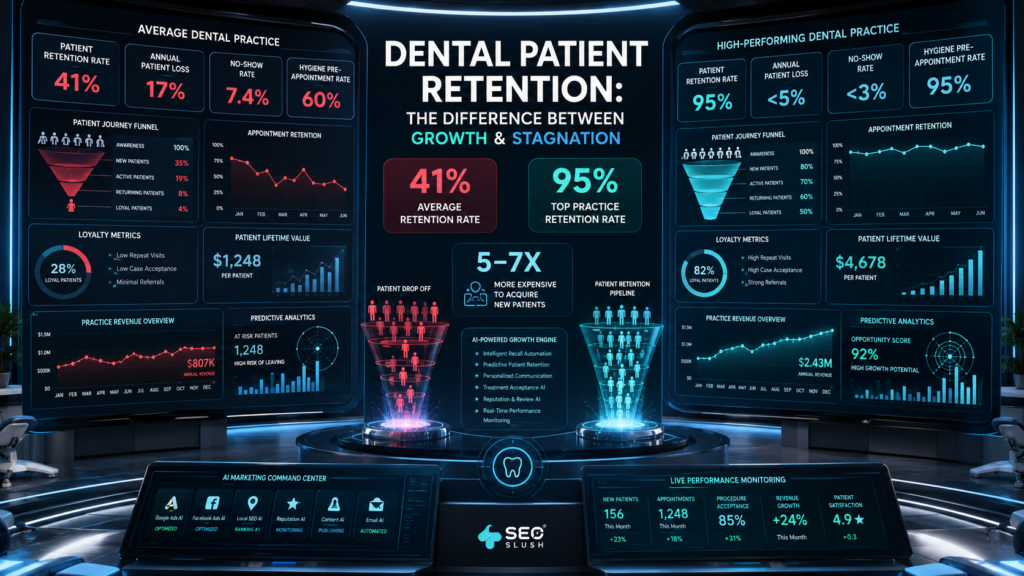
Acquiring a new dental patient costs five to seven times more than keeping an existing one. Most practices pour money into ads and SEO while quietly bleeding revenue through the back door — patients who came once, felt nothing special, and never returned. The numbers behind this are uncomfortable: the average dental practice retains only about 41% of patients who visit, while top-performing practices consistently hold 85–95% reappointment rates (Planet DDS, 2025; etactics). The gap between those two numbers is where practices either grow or stall.
Before retention systems can do their job, patients need to find your practice in the first place, why your dental website isn’t showing up on Google covers the eight visibility gaps that prevent new patients from ever reaching your front door.
These dental patient retention strategies are not a generic checklist. They’re what we actually use with the practices we work with at SEO Slush — and what the data says moves the needle.
The Retention Problem at a Glance
| Metric | Average Practice | High-Performing Practice |
| Patient retention rate | ~41% | 85–95% |
| Annual patient loss | ~17% of active base | Under 5% |
| No-show rate | 7.4% of confirmed appts | Under 3% |
| Advance cancellation rate | 15.5% | Under 7% |
| Hygiene pre-appointment rate | ~60% | 85–95% |
Sources: Planet DDS 2025 (3,400 practices), etactics, Clerri 2026
1. Fix the First Visit Before You Fix Anything Else
Retention starts before the cleaning ends. The first appointment sets the emotional tone for every future one — and most practices lose patients here without ever knowing it.
What breaks the first visit:
- Patient sits in the waiting room 20+ minutes without acknowledgment
- Rushed exam with no clinical explanation given
- No clear next step at checkout — just a vague “see you in six months”
What works:
- Welcome patient by name when they walk in
- Doctor introduces themselves with a brief, non-clinical conversation
- A confirmed next appointment before the patient leaves the building
2. Book the Next Appointment Before They Leave the Chair
Practices that pre-schedule the next appointment chairside achieve hygiene pre-booking rates of 85–95%. Practices relying on recall outreach after the fact average closer to 60% — a gap that silently compounds every single month.
Once a patient walks out without a future appointment confirmed, you are competing against inertia. And inertia wins most of the time.
Script it at checkout: “Let me get your next cleaning on the calendar now while you’re here.” Not “Would you like to?” — just do it.
3. Build a Layered Recall System
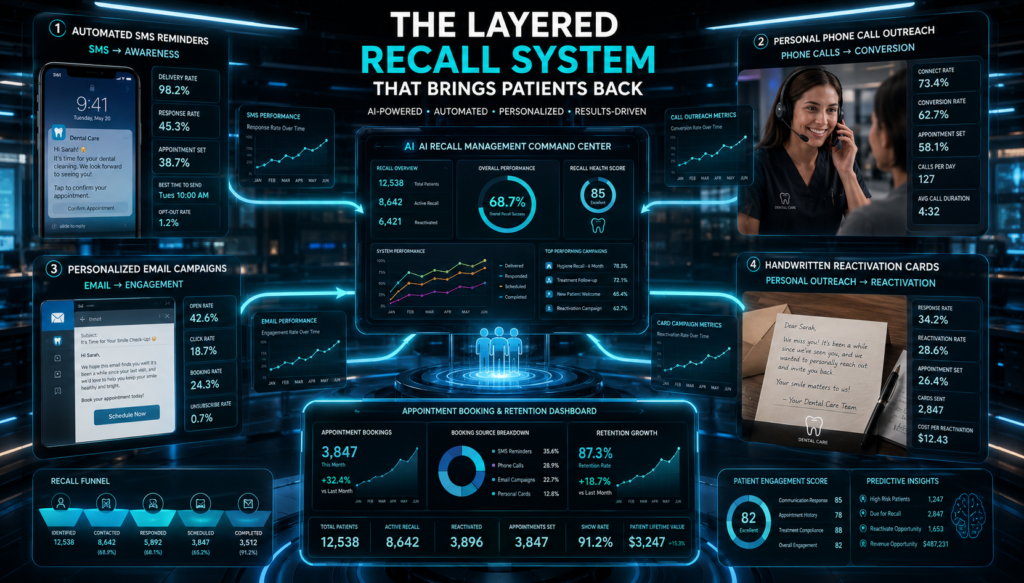
Automated texts are a starting point — not a strategy. Most practices we audit show a 30–40% gap between reminders sent and appointments actually booked.
| Recall Layer | Who It Reaches | Conversion Strength |
| Automated text | All patients | Low–Medium |
| Personal phone call | Non-responders | Medium–High |
| Handwritten card | 2+ year inactives | High |
| Email sequence | Digital-first patients | Medium |
The fix: Layer all four. Automation handles volume; the personal call handles conversion.
4. Respond to Every Review Within 48 Hours
According to Birdeye’s 2025 data, 81% of all dental reviews are posted on Google, and nearly 1 in 2 patients have avoided a provider due to poor or unanswered reviews. Reviews are not just reputation management — they are retention management.
What to do:
- Respond to every review — positive and negative — within 48 hours
- Reference something specific from the review (not a copy-paste reply)
- For negative reviews: acknowledge, apologize briefly, take it offline
What not to do:
- Ignore reviews because “they’re mostly positive anyway”
- Use the same response template for every review
- Respond defensively to complaints publicly
5. Send a Post-Appointment Check-In (Not a Bill)
Most follow-up communication from dental practices is either a billing reminder or a promotion. A single check-in SMS sent 24 hours after any procedure — implant, extraction, or whitening—does something most marketing never achieves: it makes a patient feel cared for, not processed.
One sentence. One SMS. 24 hours post-procedure. That’s the whole tactic.
6. Personalize Communication Beyond “Dear Patient”
Patients recognize bulk emails immediately. Practices using PMS data to personalize touchpoints consistently outperform those sending generic newsletters.
High-ROI personalization triggers:
- Birthday message (warm tone, no coupon attached)
- Anniversary-of-first-visit note
- Post-treatment check-in tied to specific procedure
- “It’s been a while,” reactivation with a personal tone
Start with the birthday text. It’s the simplest trigger that consistently generates real replies.
7. Train Front Desk Staff on Retention, Not Just Scheduling
The front desk is the most important retention touchpoint in any practice — and in most offices, it receives zero retention training. A dismissive response to a reschedule request or a rushed checkout can undo everything the clinical team built during the visit.
What a 15-minute monthly team huddle should cover:
- How to handle a cancellation warmly without losing the rebooking
- How to ask for a review naturally at checkout
- How to respond to a complaint without getting defensive
- How to reconnect with a patient who hasn’t been in over a year
8. Launch an In-House Membership Plan for Uninsured Patients
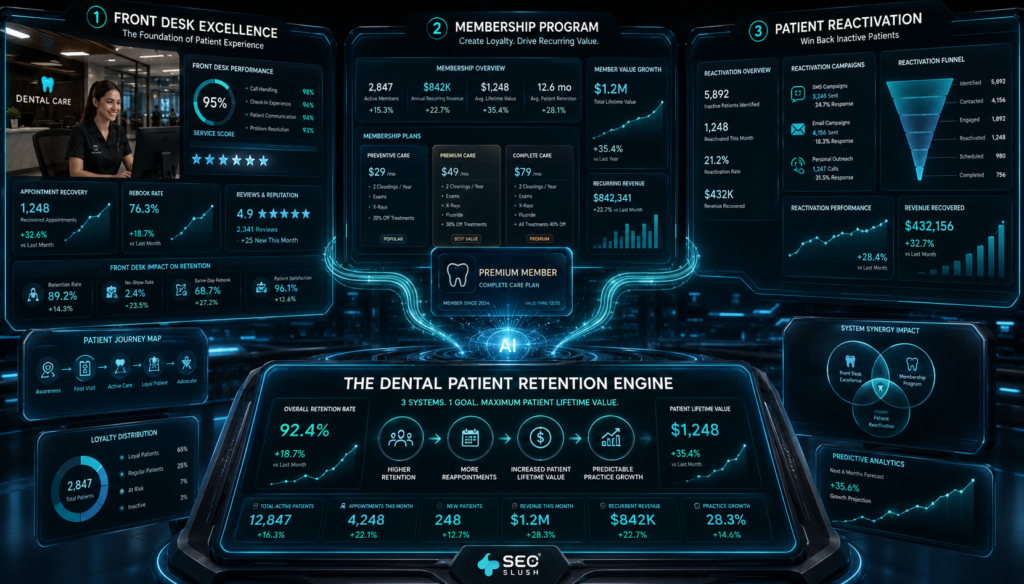
Around 74 million Americans have no dental insurance. Without coverage for a twice-yearly recall, these patients have no external mechanism keeping them connected to any practice, including yours.
For the 74 million patients who do carry some form of coverage, the most commonly misunderstood limit is the lifetime maximum, our guide on what lifetime maximum means in dental insurance and how it works explains exactly what it covers, which services it affects, and which plans in 2026 offer the highest limits.
A basic in-house plan typically includes:
- Annual fee covering 2 cleanings, 1 exam, and X-rays
- 10–20% discount on all additional treatments
- No waiting periods, no claim forms, no deductibles
This is one of the highest-ROI retention moves for practices in mid-market U.S. cities — and the majority still aren’t using it.
9. Reactivate Lost Patients Before Chasing New Ones
Any patient who hasn’t visited in 18+ months is dormant, not gone. The trust baseline already exists, which is why reactivation campaigns convert at a far higher rate than new patient acquisition at a fraction of the cost.
3-touch reactivation sequence:
| Touch | Channel | Timing | Message Angle |
| 1 | SMS | Day 1 | “We miss you” — warm, brief |
| 2 | Day 4 | Value reminder + easy booking link | |
| 3 | Personal call | Day 10 | Team member, not a script — genuine |
Pull your 18-month inactive list quarterly. Assign a real staff member to outreach — not just an automated blast.
10. Make Booking and Rescheduling Actually Easy
67% of patients want online booking. Only 26% of dental practices offer it (archdentalmarketing.com, 2026). That gap is a direct retention leak — patients who can’t book on their schedule move to a practice that lets them.
The baseline expectation for patients under 45:
- Online booking available 24/7
- Mobile-friendly patient portal
- SMS or app-based appointment reminders
- Easy, no-hold rescheduling option
Convenience is now a clinical factor in patient loyalty. Friction kills retention quietly, and the patient never tells you why they left.
Conclusion
Every one of these dental patient retention strategies works better when connected — not treated as isolated tactics. The practices that grow lifetime patient value year over year treat retention as a system: consistent, personal, and measured. Fix the first visit. Lock in the next appointment. Layer your recall. Make reviews a daily habit. Plug the front desk gaps. Do this consistently and retention takes care of itself.
Ready to find out exactly where your practice is losing patients? Book a free Dental Visibility Audit with SEO Slush — we’ll show you what’s broken and what to fix first.

27 thoughts on “10 Dental Patient Retention Strategies That Actually Work”
Solid platform with a great community vibe. It is always exciting to see who is winning today. I am really enjoying bdtak999.
The bonuses are actually legit here. I managed to hit a decent win last night and the withdrawal was super quick. phjiliboss is my new favorite spot.
Really enjoying the current promotions. The gameplay is fluid and the wins feel rewarding. Jump into pkq98 and see for yourself.
I’ve been looking for a reliable platform and this one really delivers. The login process is super smooth and the games are top-notch. Highly recommend checking out 8k8ocomlogin for a great experience!
Super easy access and the loading speed is impressive. I love how everything is organized, making it easy to find my favorite games. Great vibes over at 991jililink.
Super easy registration and the deposit process is seamless. I love how straightforward everything is on jili49app. Five stars from me.
Finally found a place where the login process is actually seamless. No more endless loading screens. Great experience so far with jili356comlogin.
Top tier service and the winning odds are actually decent. I really appreciate the transparency of this site. Join idboswin77 for a win.
[8891]1win লগইন এবং অ্যাপ ডাউনলোড – বিকাশ দিয়ে ক্যাসিনো গেম খেলুন,1win লগইন করে অনলাইন স্লট গেম খেলার নিয়ম জানুন এবং 1win app download apk করে নিন। বিকাশ দিয়ে ক্যাসিনো ডিপোজিট করে আজই খেলা শুরু করুন। visit: 1win
Really liking the rewards system on this app. It keeps things exciting and the prizes are actually attainable. bdbb444app is my new favorite.
Discovering arjugabetonline felt like finding a hidden gem for anyone who enjoys both sports betting and casino games. The mobile version works perfectly on my tablet and the graphics are sharp without draining too much battery. I appreciate how their loyalty program rewards regular players with practical perks instead of empty promises. It is refreshing to play where fairness and transparency come first. arjugabetonline
Total game changer! The variety of games here is insane and the graphics are stunning. I spend way too much time on iny1games these days but it is totally worth it.
Found this place through a friend and I am glad I did. Everything is professional and the customer support is actually helpful. 6733aabet
Great community vibe and the games are always updated. It feels like a real digital pub for gamers. I’m spending most of my free time on ph203pub now.
The best platform for local players. The login is stable and the promotions are actually rewarding. Give megapariloginbd a try.
The atmosphere of this casino is top notch. It really feels like a premium experience from the moment you sign up. Visit parkjilicasino today.
Safe, secure, and very efficient. I have had zero issues with my deposits and withdrawals here. puasbetlogin is the real deal.
The registration process was a breeze and I was playing in under two minutes. Really impressed with the game variety here. Give jili65loginregister a go, it is totally worth it.
Been playing here for a month now and the bonuses are legit. It is a great place for anyone looking for reliable wins. Check out vnnohu188.
[855]vikingluck লগইন এবং অ্যাপ ডাউনলোড | বিকাশ ক্যাসিনো ও স্লট গেম,vikingluck লগইন করুন এবং বিকাশ দিয়ে অনলাইন ক্যাসিনো উপভোগ করুন। সেরা স্লট গেম সাইট থেকে আপনার প্রিয় গেমটি বেছে নিন এবং আজই অ্যাপ ডাউনলোড করুন। visit: vikingluck
[9435]Melbet বাংলাদেশ লগইন ও অ্যাপ ডাউনলোড | বিকাশ ক্যাসিনো ডিপোজিট,melbet বাংলাদেশ লগইন করে লাইভ ক্যাসিনো বোনাস অফার পান এবং অনলাইনে স্লট গেম খেলার নিয়ম জানুন। আজই অ্যাপ ডাউনলোড করে খেলা শুরু করুন। visit: melbet
[2759]copybet লগইন ও অ্যাপ ডাউনলোড | বিকাশ ক্যাসিনো ডিপোজিট,copybet লগইন করে উপভোগ করুন লাইভ ক্যাসিনো বোনাস অফার এবং অনলাইন স্লট গেম নিয়ম। বিকাশ দিয়ে ক্যাসিনো ডিপোজিট করে আজই খেলা শুরু করুন। visit: copybet
Finally found a site that actually delivers on its promises. The user interface is clean and the experience is just top notch. Love using brtitiwin
Super easy to get started and the login process is a breeze. It is my go-to spot for some quick gaming sessions. Highly recommend jilicologin to everyone.
This site is pure luck and fun! I love the competitive feel and the way the rewards are structured. It keeps me coming back every single day. 888win888win9
I’ve been playing here for a few weeks now and the payouts are surprisingly fast. Definitely one of the smoothest experiences I’ve had lately. Check out brcassino222 for a great time.
As an Aussie who loves a bit of sport and casual gaming this site nails the vibe we all enjoy. The loyalty program actually rewards consistent players and the support team replies within minutes. I especially love how they keep the promotions seasonal so it never feels stale. Definitely my favorite spot to log on and unwind. pointsbetaustralia